
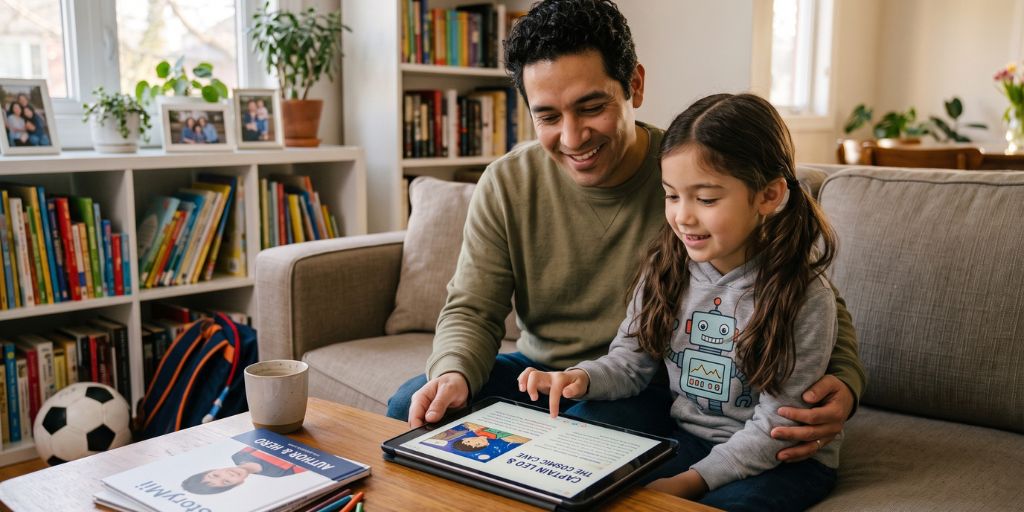
From Reluctant Reader to Author: How Co-Creating Stories Unlocks a Child's Confidence
Most of us know the uneasy feeling that comes with handing over a tablet. We watch our kids stare at a glowing screen, swiping through endless feeds or watching frantic animations, and the parental guilt creeps right in. Screen time gets a bad reputation, and often for good reason. But what if screen time turned your child into a confident creator instead of a passive viewer?
There is a profound difference between a screen that demands total consumption and one that sparks creative action. When we shift a child from merely consuming other people's media to actively designing their own stories, something remarkable happens to their self-esteem and their relationship with reading.
The Problem: When Books Feel Imposed Rather Than Owned
For a reluctant reader, opening a book can feel less like an adventure and more like a test. Traditional books arrive fully formed. The plot is set, the characters are established, and the reading level is fixed. If the vocabulary feels slightly too advanced, or if the subject fails to grab their imagination, frustration sets in quickly.
When reading feels like a top-down chore, children retreat into passive entertainment. They seek out games and video streams because those environments offer immediate agency. In a game, they control the steering wheel. With a traditional book, they often feel like they are just along for a difficult ride.
The Proof: Agency and Active Creation Build Literacy
The key to unlocking reading motivation is giving children ownership over the words they encounter. Educational research shows that when children have a voice in the narrative, their entire approach to reading shifts.
What the Research Shows:
- Studies on self-determination reveal that children show significantly higher task persistence and reading stamina when they have autonomy over the content.
- Active learning principles confirm that when kids generate or manipulate story ideas themselves, their retention of new vocabulary increases compared to passive text exposure.
- Shared digital reading experiences between parent and child create stronger emotional connections and higher language gains than solo digital consumption.
Three Practical Ways to Turn Passive Screen Time into Creative Literacy
Transitioning a reluctant reader into an enthusiastic creator does not require hours of complex lesson planning. Here are three actionable ways to build that bridge tonight.
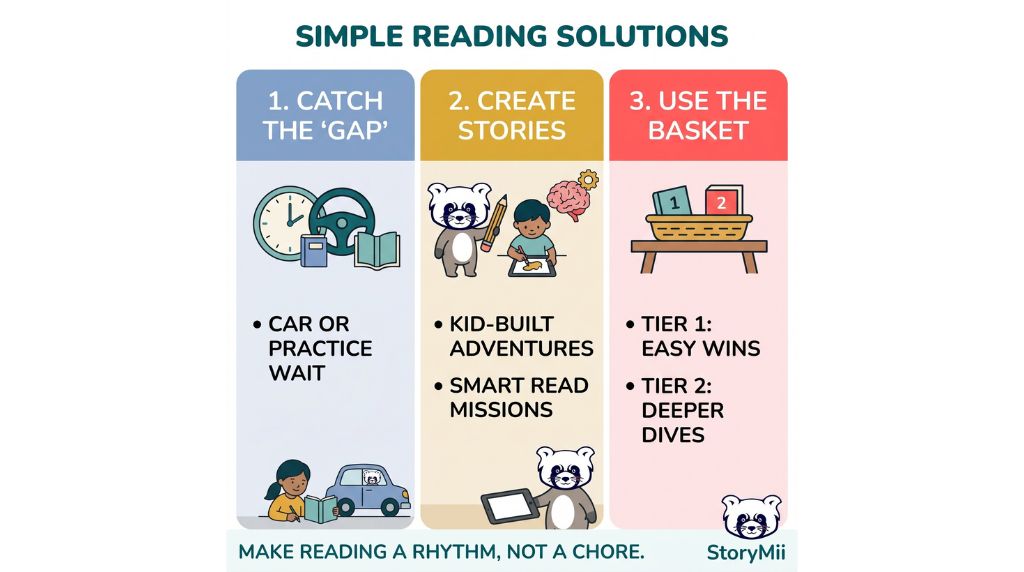
1. The "What Happens Next?" Dinner Table Pitch
You can spark the author mindset without turning on a single device. During dinner or on the drive home from school, start a simple story with an open-ended cliffhanger: "A tiny robot just knocked on our kitchen window holding a map. What is the very first thing we do?"
Take turns pitching the next plot point. This simple back-and-forth verbal play demystifies storytelling. It teaches children that narrative arcs are built through choices, which primes their brains to look at written books with curiosity rather than dread.
2. Cast Your Child as the Hero on StoryMii
When kids see themselves on the page, reading resistance drops instantly. Use StoryMii's Custom Adventure Creator to build a story together where your child is the star.
- Pure Creative Ownership: Imagine your child seeing themselves as the brave captain of a starship navigating an asteroid belt, or a clever detective solving a mystery in their own neighborhood.
- Safe and Empowering Sandbox: StoryMii provides a secure, ad-free environment without toxic algorithms or overstimulating animations. Because your child controls the theme and the characters, they are eager to read every word to see how their own ideas unfold.
3. Cement Retention with StoryMii's Adaptive Reading Missions
Reading comprehension grows through active participation, not passive scanning. After co-creating a story on StoryMii, take advantage of the platform's adaptive learning features:
- Adjustable Reading Levels: The platform calibrates vocabulary and complexity to your child's exact reading stage. As their confidence grows, the platform levels up with them, keeping the challenge in that optimal sweet spot between boredom and frustration.
- AI-Powered "Skill Checks": Once your custom adventure finishes, StoryMii generates interactive quizzes based specifically on the tale you built together. It feels like leveling up in a game, reinforcing comprehension and active retrieval without feeling like classroom homework.
The Takeaway
Raising a confident reader does not mean banishing technology from the living room. It means swapping passive consumption for shared creative tools that respect your child's developing mind. When you hand them creative control, reading stops being a battle and starts being an adventure you share together.
Ready to give your child the pen? Try creating your first personalized adventure free today at StoryMii.com!
📚 References & Cited Research
- Deci, E. L., & Ryan, R. M. (2000). The "What" and "Why" of Goal Pursuits: Human Needs and the Self-Determination of Behavior. Psychological Inquiry.
- Deterding, S., et al. (2011). From Game Design Elements to Gamefulness: Defining "Gamification". Proceedings of MindTrek Conference.
- Karpicke, J. D., & Blunt, J. R. (2011). Retrieval Practice Produces More Learning than Elaborative Studying with Concept Mapping. Science.
- Csikszentmihalyi, M. (1990). Flow: The Psychology of Optimal Experience. Harper & Row.
- Bus, A. G., Takacs, Z. K., & Kegel, C. A. (2015). Affordances and Limitations of Electronic Storybooks for Young Children's Emergent Literacy. Developmental Science.